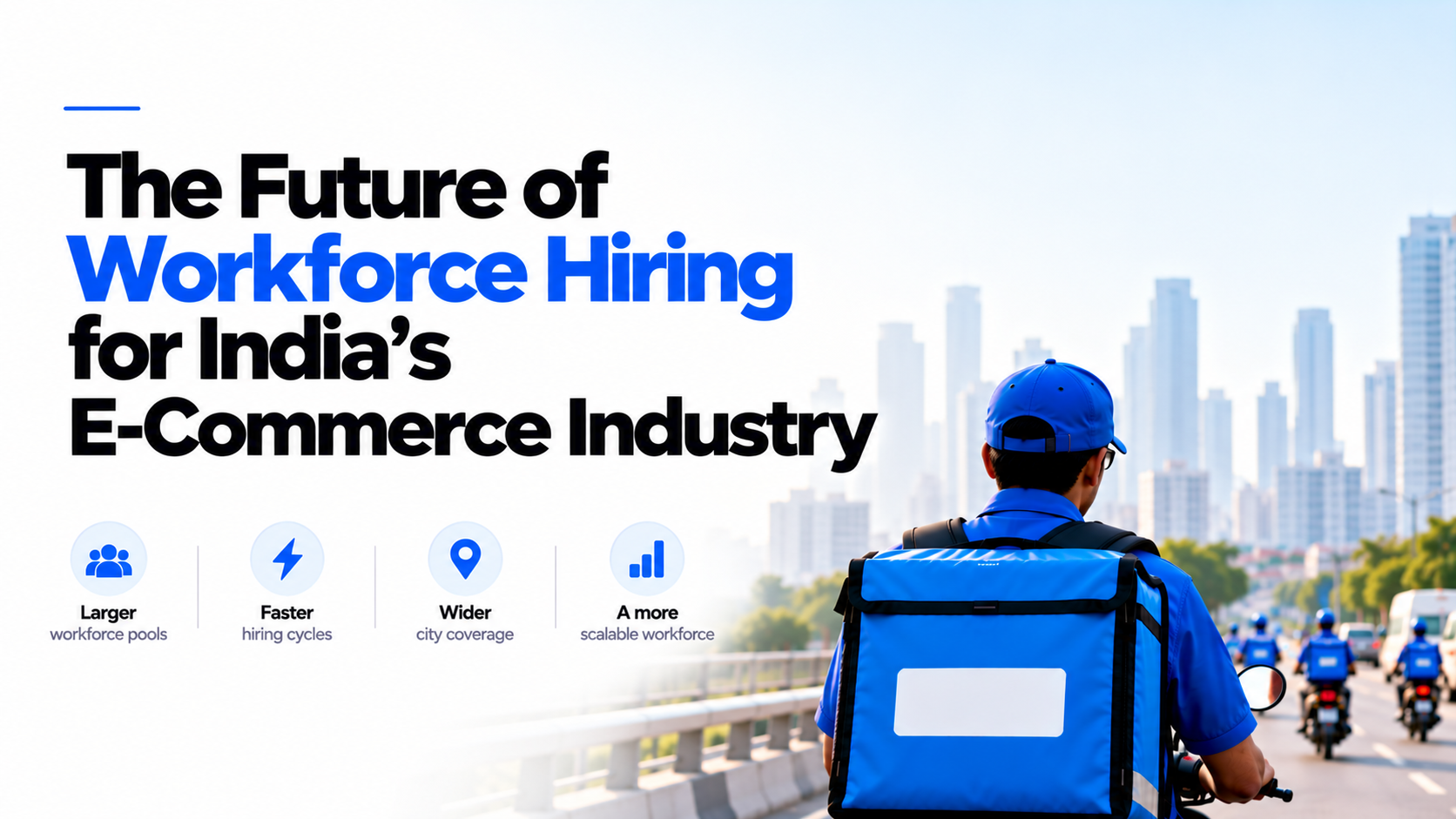
The Future of Workforce Hiring for India's E-Commerce Industry
The tool room of a Rajkot auto-component works taught him that the die is cut before the first part exists. One shape, made in steel and made in advance, decided a thousand identical parts that followed it for months; the parts never argued with the die, and the men who cut it never met the customer who used them. Tolerances were checked with gauges rather than opinions, and a die was re-cut on a schedule, not after a breakdown, because the plant knew what a worn tool cost in scrap. The die, he learned, does the arguing once; the parts just follow.
Today he is the head of workforce foresight at an e-commerce company that hires across dozens of cities, and the tool room came with him. His colleagues still describe hiring with the last decade's verbs, post, source, fill, while he describes it as cutting dies: supply found before the festival asks for it, documents flowing before the inspector calls, fleet economics answered before the first battery arrives. The difference, he says, is not optimism about the future; it is deciding who pays for the future, and the answer is always cheaper when it is paid in advance. His desk's output looks boring on purpose: supply maps by catchment, lead-time tables by role, tolerance sheets for how far a funnel may drift before somebody is woken up.
That distance between the demand arriving and the systems built to serve it is what the future of workforce hiring for india's e-commerce industry means in practice: the playbook that expires first, the supply map moving outward, the fleet going electric, formalization becoming the default, matching replacing advertising, hiring run as a standing function, the worker's portable side, and the few things that will not change at all. The guide takes the forces one at a time, because a die is cut one surface at a time.
The Playbook That Got Us Here Expires First
A future of gig hiring India's largest employers have started naming in strategy decks does
not begin with a new tool; it begins with the old playbook expiring. The last decade's verbs were post, source, fill: demand arrived, a campaign answered it, the campaign ended. Every force now reshaping the industry attacks that sequence at once, volume that compounds, geography that widens, workers who choose like customers, and regulation that will not stay optional. When all four move together, campaigns cannot hold the calendar, and the verb that replaces fill is staff, as a standing act. A campaign has a closing date; a standing act has a maintenance schedule, and that difference decides who is still hiring well in the second year.
The scale underneath the shift deserves respect. BBC reporting puts India's gig workforce at roughly twelve million people, and e-commerce sits near the front of the queue that keeps adding to it. A function that once handled a festival spike now runs a permanent national operation, and functions that run permanently get engineered differently: fewer heroic weeks, more repeatable ones, and a budget that treats capacity as an asset rather than an event.
The e-commerce workforce trends India's boards read today already sketch the change in careful language: hiring cycles lengthening into programs, attrition lines moving into board packs, and headcount giving way to capacity as the word of record. Trends documents do not build anything by themselves, but they do announce what the next budget will be asked to build, and the next budget, increasingly, is asked to build systems rather than campaigns.
The Supply Map Moves Outward
The e-commerce talent supply India's next decade will draw on sits deeper in the map than the last one's did. Metro funnels are mature and expensive, and the marginal joiner increasingly lives in a tier-2 or tier-3 catchment, hears about work through a person rather than a poster, and decides on distances the metro playbook never measured. Supply does not disappear in the metros; it stops being cheap, and cheap was where the old model kept its margin.
The channel most likely to redraw that map is women gig workforce hiring India's programs have only begun to open properly: participation that rises when work sits near home, timings that survive household schedules, and safety that is designed rather than promised. Employers who treat that channel as a first-class line in the plan will find the supply the next decade keeps promising; employers who treat it as a poster will keep wondering where everyone went.
The planning consequence is uncomfortable for central teams: the future supply curve is written in pincode dialects, not in one national accent. A catchment fills through its own geometry, its own references, its own paydays, and a funnel that reads well in one city can sit empty in another for reasons no dashboard explains. The companies that learn the dialects early, through local presence and local language, will be reading their supply a full season before their competitors finish reading a slide. None of this requires a new department; it requires the existing one to spend more of its week where the supply actually lives.
The Fleet Goes Electric
The electric delivery fleet hiring India's metros are moving to changes the hiring question itself. A rider on an EV is a slightly different hire: range and charging rhythms shape which shifts are practical, vehicle access becomes part of the offer, and battery economics enter the joining conversation without being invited. None of this is exotic, and all of it changes who says yes; the employers who answer first will hire from a pool the others have not met.
The second-order effects reach the whole funnel. EV fleets concentrate on dense routes where charging makes sense, which redraws catchments; financing and maintenance become part of the work's real economics; and training gains a module that did not exist five years ago. The hiring function inherits every one of these lines, because the fleet is not a procurement decision wearing wheels; it is a workforce decision wearing a battery. Even the interview changes: a candidate who asks where charging happens is asking a question the operation should have answered before the posting went live.
The future of delivery hiring India's operations teams are preparing for, in other words, is not the same job with newer vehicles. It is hiring with a larger brief: energy, geometry and finance folded into the oldest question on the desk, which is who shows up. The teams that fold it earliest will spend least, because every one of those questions gets more expensive when it is answered late.
Formalization Becomes the Default
The formalization of gig work India has legislated since 2020 keeps moving one direction only: toward coverage. The Code on Social Security, 2020 named gig workers in national law; Rajasthan's 2023 and Karnataka's 2024 state acts built welfare boards funded by a levy that starts at one to two percent and is capped at five; Ayushman Bharat's 2025-26 extension brought health cover into the offer. Each step converts what was once an employer's differentiator into the sector's baseline, and baselines do not compete; they just become the price of showing up.
The rails under that baseline are national. The e-Shram registration gives every worker one universal identity number, and documents that travel with the worker instead of being rebuilt per employer quietly lower the cost of every future join. Formalization done well is not paperwork stacked on top of hiring; it is infrastructure laid underneath it, and infrastructure is the rare cost that compounds in the employer's favour.
The forward-looking consequence is a change in what candidates ask. A decade ago the question was pay per drop; increasingly it is what comes with the work. Hiring organizations that can answer in specifics, cover, registration, predictable earnings, will recruit past organizations that can only answer in rates, and the gap will widen as the acts mature, because the workers who ask the better questions are the workers worth keeping. The acts also reward patience: coverage that starts as a cost line becomes a hiring line within a few quarters, as the covered employer's offer quietly outbids the uncovered one at the same rate.
Matching Replaces Advertising
The AI in gig hiring India's platforms are shipping today is less about spectacle and more about subtraction: less distance between worker and work, less paperwork repeated, less time from application to first shift. Matching quality is the quiet metric, because a market where the right worker sees the right shift in minutes does not need the volume of advertising the last decade used as ballast, and the money saved there is money the operation can spend on the first week.
Verification speed is the second subtraction. Identity, right-to-work and history checked once and reused everywhere turn onboarding from a queue into a lookup, and lookup-speed onboarding changes worker behaviour: a market that answers in hours keeps workers engaged between shifts instead of losing them between applications. Speed here is not a feature; it is the difference between a labour pool and a labour pulse. The habit to build now is deliberately boring: one verification, many reuses, and an audit trail that reads like a log rather than a memory.
None of this removes judgement; it moves judgement earlier. The tooling decides who is available, and the hiring function still decides who is ready, which is a different question with the same urgency. The organizations that confuse the two will automate their own ambiguity, and the ones that respect the line will spend their people on the decisions machines cannot take.
Hiring Becomes a Standing Function
Hiring as infrastructure India's next decade demands is built from standing parts: a planning desk that owns the forecast, a supply layer that owns the pool, a compliance spine that owns the documents, and reviews that own the truth. None of these parts is new; what is new is running them as one system all year instead of assembling them each season and disassembling them after, because a machine that is rebuilt twice a year never gets the hours that make it good.
The arithmetic behind the shift is public. NITI Aayog projects India's gig workforce growing from 7.7 million in 2020-21 toward 23.5 million by 2029-30, and e-commerce is one of the engines doing the pulling. Volume that triples does not forgive systems that restart; it rewards the teams who keep the machine warm between peaks, and it punishes the ones who mistake the peak for the plan.
The tool room's oldest lesson lands here. A tool used occasionally can be improvised, but a tool used daily must be engineered, and hiring in the coming decade is a daily tool. Daily tools get owners, budgets, tolerances and maintenance schedules, which is a more honest description of the future than any campaign calendar ever printed. What the tool room adds to that list is humility about wear: a tool that is not maintained is a tool auditioning for failure, whatever the org chart calls it.
The Worker's Side of the Future
A portable work history India's workers can carry between platforms changes the hiring conversation from audition to record: ratings, completed shifts and verified documents that travel with the person shorten every future join, and reliability becomes an asset the worker owns rather than a claim the employer verifies from zero. The role categories published publicly are the visible edge of that standardization: a delivery partner, a picker, a sortation associate defined the same way everywhere is the first step toward a record that means the same thing everywhere.
Portability also changes loyalty's shape. The coming decade's workers will run portfolios rather than probation periods: multiple apps, multiple income lines, and a public record that follows them across all of it. Employers who see that as a threat will fight the record; employers who see it as infrastructure will plug into it, because a worker whose history is visible arrives pre-qualified, and pre-qualified joins are cheaper for everyone. The platform side shows the direction, as GigKaro's hiring platform demonstrates with verified profiles, ratings and work history that make a worker legible to any employer before the first shift.
The respect consequence matters too. Records that travel raise the stakes of fair treatment, because a worker with a portable history has options, and options change tone on both sides of the conversation. The future hiring market will feel less like a gate and more like a market, and markets reward the side that makes itself easy to choose. Employers will feel the change first as faster answers: candidates who arrive knowing the market, negotiate like regulars, and leave records that make the next employer's join easier than the last.
What Does Not Change
Outcome based gig hiring India's contracts will increasingly pay for survivors and covered shifts rather than submissions, but the principle underneath is older than any of this technology: pay for what the business actually consumes. The future's contracts will be sharper, its dashboards calmer, its disputes rarer, and its principle unchanged since the first purchase order was ever signed.
Reliability stays the product. Every force in this chapter, wider supply, electric fleets, formalization, matching, standing functions, portable histories, ends at the same counter: did the shift get covered, on time, by someone verified, at the cost the plan promised. The future of hiring is full of new machinery wrapped around one old promise, and the organizations that keep the promise will be allowed to keep the machinery. The counter does not care which decade it is standing in, which is why the constants make better strategies than the trends do.
The day-one experience stays decisive too. Whatever the tools become, somebody still joins a platform on a specific morning, nervous, carrying documents, and deciding within an hour whether the work is real. Whether that morning goes right decides more than any strategy deck, and the future belongs to organizations that treat the first day as the product demo it has always been.
Where GigKaro Fits In
A future of hiring needs a supply layer already organized at the grain the future runs on, and that is what GigKaro provides. GigKaro is a pincode-level gig hiring network: earnings visible on every listing, employer verification shown up front, and openings matched to the distance a candidate will actually travel, which is the local grain the moving supply map is heading toward. You can scan the live gig jobs board to see supply as candidates see it, or open a city board such as delivery partner jobs in Bengaluru to watch one market's demand held as a standing pool rather than a one-time campaign.
Breadth matters because the next decade's hiring is written market by market. The locations GigKaro covers trace a footprint designed to deepen pincode by pincode, and the role pages, from warehouse and packing jobs in Bengaluru to the delivery and EV rider categories, give the coming decade's hiring function a common template: one register, many markets, every market's bench visible before the demand arrives.
And for the workers who will carry this future, the same door opens in their own direction: the step-by-step guide to finding gig work near you walks through documents, applications and the first week in plain language, because the future of hiring, whatever it brings, still runs on first days that went right.
Back in Rajkot, the tool room still cuts dies for parts nobody has ordered yet, and the desk he now runs keeps the same faith in prepared shapes: supply found before the festival asks, fleet economics answered before the first battery arrives, documents flowing before the inspector calls, reviews kept on the calendar whether or not the week is busy. The future of hiring will not be predicted; it will be tooled. Cut the die ahead of the metal, check the tolerances weekly, re-cut before it wears out, and the parts follow. Kaam Karo. Kamao.