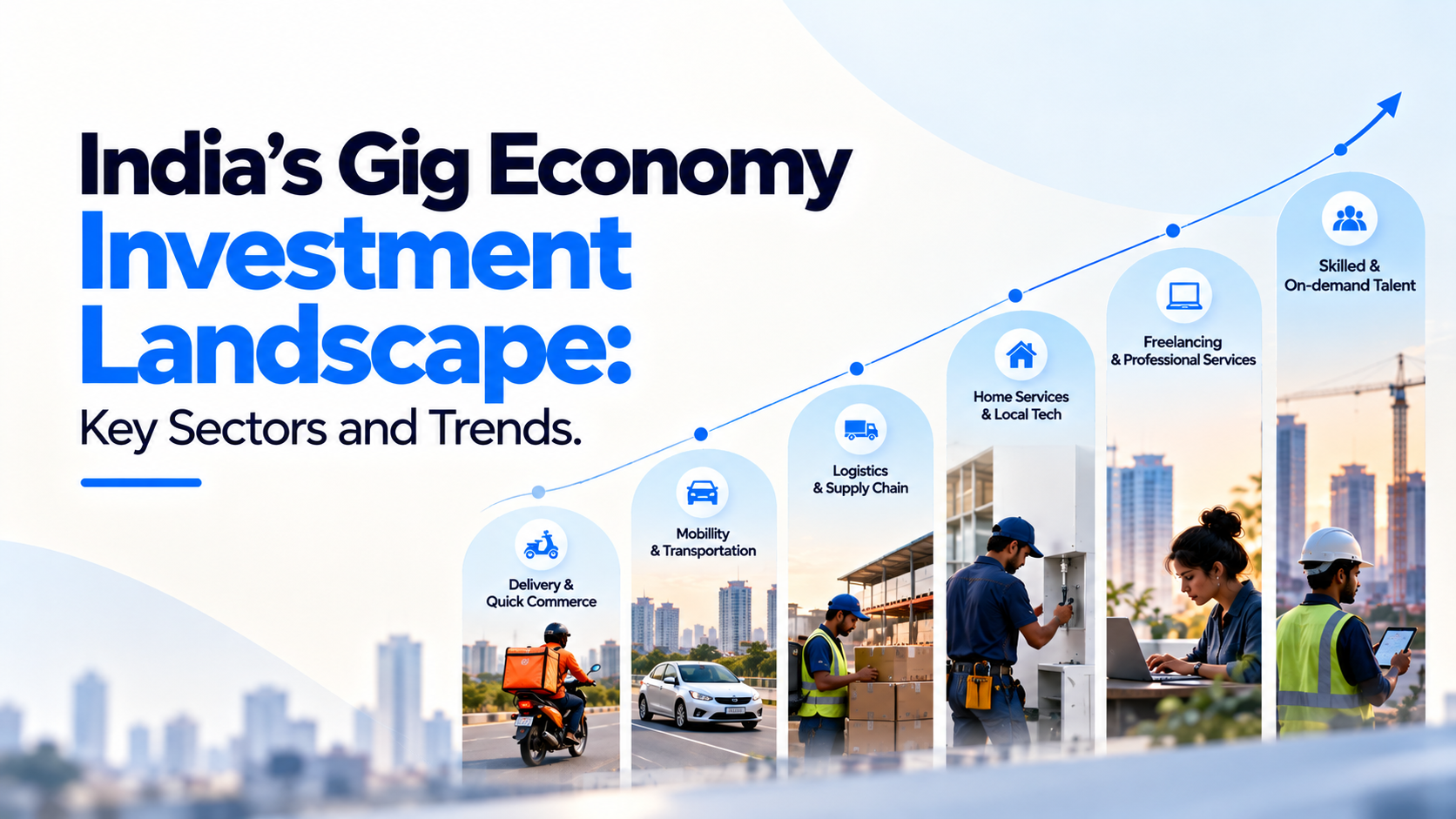
India's Gig Economy Investment Landscape: Key Sectors and Trends
All storiesThe clearest education in India's gig economy that money can buy is not an MBA elective; it is eighteen months spent riding. The analyst at a Bengaluru early-stage fund knows this from the inside: six years ago he delivered food through a metro winter to pay for his own degree, and today he screens the deals that hope to employ two million more people like the one he used to be. He reads cap tables the way he once read heat maps, and he carries one conviction his peers lack: he knows what a unit of gig work actually costs, because he has been the cost line. India's gig economy investment landscape is best read by people like him, from both sides of the app. Roughly twelve million workers strong and heading toward 23.5 million by 2029-30, the sector is no longer a bet on an app category; it is a spread of sectors, each with its own economics, its own regulatory exposure and its own maturity curve. This article maps that landscape sector by sector, walks through the trends now repricing it, from profitability discipline to worker finance, and closes with the checklist capital should run before writing a cheque.
The Landscape: One Labour Force, Many Bets
The gig economy investment landscape in India is often described as a single story, but it is better understood as several stories sharing one labour force. Mobility, food delivery, quick commerce, logistics, home services and staffing platforms compete for overlapping pools of workers while answering to completely different demand curves, capital intensities and margin structures. An investor who treats them as one asset class will misprice all of them. What they share is the supply side: a workforce of roughly twelve million, growing near 17 per cent annually against 1 to 2 per cent for conventional employment, and concentrated in the delivery, logistics and warehouse roles the smartphone made legible.
The rails were laid by gig economy startups India produced at a remarkable pace: Ola, founded in Mumbai in 2010, and Uber's 2013 entry proved that demand-matching could scale; Swiggy, founded in 2014, and Zomato's delivery arm, from 2015, applied the same engine to food; and the decade that followed seeded specialists in groceries, B2B logistics, home services and blue-collar staffing. Venture capital in gig economy categories then followed the consumer-internet pattern the country already knew: subsidy-led land grabs, a correction, and a slower build toward durability. That sequence matters, because each sector entering the landscape today inherits the lessons, and the discipline, of the ones that went first.
The size of the prize justifies the attention. Official projections published through NITI Aayog put the workforce at 23.5 million by 2029-30, about 4.1 per cent of national employment; Redseer's range runs to 17 to 21 million platform workers by 2030; and BCG's scenario sketches up to 90 million platform-enabled jobs worth about 1.25 per cent of additional GDP. Behind the top line sits a deeper shift: task-work is becoming legible, counted and regulated, and legibility is what turns a market into an asset class. The rest of this article reads the landscape the way the former rider turned analyst would: sector by sector, then trend by trend.
The Sector Map: Where the Money Actually Sits
Reading gig economy sectors India counts as the first discipline, because the sectors differ in what kind of business they actually are. Mobility, from Ola and Uber to bike taxis such as Rapido, is a matching business with thin margins and heavy local regulation. Food delivery, where Swiggy's roughly 6.9 lakh and Zomato's about 5.7 lakh partners form the sector's most visible workforce, is a three-sided marketplace living on commissions that run 15 to 30 per cent. Quick commerce is something else again: platforms such as Blinkit, Zepto and Instamart own inventory and dark stores, which makes them full-stack retailers that happen to hire gig labour at volume.
The business-to-business and services layers run on quieter economics. Logistics platforms such as Delhivery, Shadowfax and Porter sell per-shipment capacity and hire riders by the shift, so their gig workforce scales with e-commerce volume rather than consumer appetite alone. Home-services marketplaces such as Urban Company organise beauty, repairs and cleaning into managed supply, taking a cut of a service fee rather than a delivery commission. And the staffing layer, listing boards such as Apna and WorkIndia alongside matching platforms such as GigKaro, monetises the hiring flow itself, the layer every other sector must pass through to fill its shifts. That is why blue collar staffing investment India has quietly gathered pace: the layer is capital-light, its product is verified supply, and every other sector's growth increases its throughput.
The map keeps extending at its edges. Care work, elder care and telehealth are moving onto managed platforms as households formalise services they once bought informally; EV fleets are becoming employers of riders in their own right, leasing vehicles and scheduling shifts together; green logistics and recycling chains are hiring at the intersection of climate policy and city commerce. Each adjacent category inherits the rails the delivery decade already built, dispatch, verification, payouts, and adds a demand curve of its own. The skill mix, still weighted toward low-skill volume, is the compass here: every migration of work toward medium and high-skill categories marks a new hiring channel, and a new investment surface, forming at the edge of the map.
Seen together, the map explains why capital behaves differently in each corner. Matching businesses price on liquidity and take rates; full-stack businesses price on inventory turns and store-level payback; staffing layers price on coverage and verification quality. A portfolio spread across these sectors is not one bet on the gig economy repeated six times; it is six different theses that happen to draw on the same twelve million workers, which is precisely what makes the landscape worth mapping before it is worth funding.
Trend One: The Profitability Pivot Reprices Everything
The first trend reshaping the landscape is discipline. A decade of subsidy-led growth ended when capital stopped paying for it, and gig platform profitability moved from aspiration to survival condition. Incentives were rationalised, delivery zones were redrawn, and platform take rates, already in the 15 to 30 per cent band, came under scrutiny from both investors and regulators. Ground reporting such as the BBC's documentation of India's gig workforce recorded what the pivot felt like from the saddle: tighter incentive windows, longer hours for the same pay, incomes that swung with every policy change. The repricing was real, and so was the lesson: a gig platform that cannot make money per task is a subsidy with a logo.
Food delivery investment India defined the first full cycle, from cash burn to consolidation to public-market scrutiny, and quick commerce is now running the same film at higher speed. Quick commerce investment India has rotated from discounting groceries to densifying dark-store grids, because density, not discounts, is what turns ten-minute delivery into a margin story. Every new store is capex that must be amortised across enough orders, and enough riders, to pay for itself, which ties the sector's investment case directly to its hiring flow. The pattern generalises across the landscape: capital now rewards operating discipline over growth headlines, and it reprices any sector that forgets.
For portfolio construction the implication is straightforward. Early-stage corners of the landscape, staffing, worker finance, care services, still price on growth. Mature corners, mobility, food delivery, quick commerce, price on unit economics, retention and regulatory readiness. The same rupee behaves differently in each, and the sectors are linked: a profitability squeeze upstream in delivery shows up downstream as tighter hiring budgets, slower onboarding and less room for error in the matching layer.
Trend Two: Formalisation Creates New Asset Lines
The second trend converts legal obligation into investable service lines. The Code on Social Security named gig and platform workers in 2020; Rajasthan's 2023 and Karnataka's 2024 acts built welfare boards, worker IDs and transparency requirements; and aggregators now face contributions of 1 to 2 per cent of turnover, capped at 5 per cent of payouts. Every obligation needs an operator: someone must verify identities, calculate contributions, remit to boards, resolve disputes and prove compliance. In most industries regulation is a cost; in a workforce as large and newly visible as this one, it is a market.
The identity infrastructure is already national. The 13-digit e-Shram card gives every unorganised worker a portable identity, and the 2025-26 Union Budget extended Ayushman Bharat health coverage to registered gig workers, which makes registration materially valuable rather than symbolic. Around that spine, new service lines are forming: verification vendors, contribution administrators, insurance distributors, skilling providers funded through the same levy machinery. None of these existed as categories a decade ago; all of them now have statutory demand behind them, which is among the rarest foundations an early-stage investor can underwrite.
The defensibility question separates winners from vendors here. Filling a statutory form is commodity work that any competitor can replicate; owning the verified record underneath the form, and the relationship with the worker it belongs to, is not. Platforms that store consent properly, update records as workers move cities and accumulate contribution history become infrastructure the next regulation must talk to, while single-purpose vendors get absorbed or bypassed. The test an investor should apply is simple: if the rule that created the demand disappeared tomorrow, would the business still hold data, relationships or workflow worth keeping? In formalisation markets the durable asset is the record, and the record is only capturable at onboarding.
The diligence angle differs from consumer sectors in one important way: the buyer here is partly institutional. Employers buy compliance because the law requires it, not because a marketing budget manufactured a preference, so demand is steadier and less cyclical than consumer demand. The risks are equally institutional: rules change state by state, and a service line built on one notification can be repriced by the next, which argues for operators covering the whole compliance stack rather than a single slice of it.
Trend Three: The Worker Becomes a Financial Customer
The third trend moves the investment case downstream, from the app to the worker's wallet. Worker fintech India is the shorthand for a cluster of products that treat payout history as underwriting data: vehicle loans priced on a rider's weekly credits, emergency credit lines, savings and insurance wrappers, pension accruals that follow the worker across platforms. The raw material already exists, because platforms pay weekly and digitally, which means the work record is simultaneously a transaction record. For a workforce earning ₹15,000 to ₹30,000 a month that has rarely held a salary slip, the payout screen is the first financial identity anyone has ever issued it.
The concrete case is the vehicle. Fuel consumes 15 to 25 per cent of platform earnings today, and EV fleet financing India turns that cost line into a product: two-wheelers financed against payout history, batteries insured as assets, swap stations priced like fuel, all arranged through the app the rider already opens each morning. The vehicle is where the worker's biggest cost, the platform's biggest service opportunity and the lender's best collateral meet, which is why the financing layer is becoming the most tangible bridge between gig work and formal finance.
The same logic extends beyond vehicles. Insurance distribution rides on verified identity; savings products ride on predictable payout dates; pension accruals ride on the levy machinery the state is operationalising. Each product deepens the platform's relationship with the worker, and each one turns the workforce itself into a distribution channel. The sectors that understand this, rather than treating workers purely as a cost to compress, are the ones whose economics compound instead of eroding.
What breaks worker fintech is the same volatility that defines the income it lends against. Incentive changes, monsoon dips and platform policy swings make gig cash flows spikier than salaried ones, so underwriting built for EMIs misprices them in both directions, declining good borrowers and trapping weak ones in debt. The credible operators design for volatility explicitly: repayment schedules that flex with payout cycles, buffers built into credit limits, consent-based data use that the worker can actually inspect. Over-indebtedness is not just an ethical failure in this market; it is a business-model one, because a worker buried under EMIs stops riding, and the entire underwriting file loses its income. Risk pricing, not distribution, is the real moat here.
Trend Four: Consolidation and the End of Infinite Competition
The fourth trend is structure. Gig economy consolidation India has already run through mobility and food delivery, where years of subsidies left a small number of standing players, and it is now running through quick commerce, where density economics punish anyone below critical scale. The lesson repeating across sectors is that platform markets reward density: more orders per store, more tasks per hour, more workers per pincode. Fragmented competition produces subsidy wars, subsidy wars produce casualties, and the survivors inherit the market at acquisition costs they could never have bought their way down to.
Consolidation changes what investors should look for. Moats now come from verified supply, regulatory readiness and retention rather than from marketing budgets, because a worker who trusts a platform is expensive for a competitor to poach. Trust itself has become a balance-sheet item: fake gig job offers and fee-charging brokers have repeatedly burned the very workers the sector depends on, and platforms that invest in verification and honest listings are buying durability that no discount campaign can replicate.
The staffing layer consolidates by a different route: through coverage. A matching layer present in many cities reads demand earlier, fills roles faster and accumulates the work histories that make future matches cheaper. Scale in this layer is not a marketing claim; it is a data advantage that compounds with every worker onboarded, every document verified and every cohort retained.
The Checklist: How Capital Should Read the Landscape
Gig economy funding trends now reward a specific kind of diligence, and the checklist is legible regardless of sector. First, unit economics per task, not per user, because tasks are the true revenue unit. Second, retention cohorts, since churn is the tax every projection forgets. Third, regulatory readiness, from levy remittance to e-Shram integration, because compliance is now a competitive line rather than a footnote. Fourth, category headroom against the skill mix of roughly 40 per cent low-skill, 32 per cent medium and 28 per cent high, which shows where the work is widening. Fifth, geography coverage beyond the metros, where the next phase of demand is compounding from a small base. Sixth, trust infrastructure: verification, dispute resolution, honest listings. A deal that cannot answer these six questions is selling momentum, not a business.
For the workers who power all of it, the rails are already live: scan live gig jobs, choose a lane from the category directory, filter by city listings, and use the step-by-step guide to finding gig work near you to avoid the classic first-month mistakes. Matching platforms such as GigKaro's gig worker hiring platform sit exactly where the landscape's promises become concrete: a verified worker meeting real demand in days rather than weeks. Investors should read that flow the way they read order books, because every successful match is the landscape's revenue unit in motion.
The metros remain the proving grounds, with delivery jobs in Bengaluru and warehouse jobs in Bengaluru posting openings across the year on the same document spine: Aadhaar, PAN, driving licence, bank account, smartphone. Where that checklist completes smoothly, the funnel converts and the sector's promises hold; where it does not, no cap table will save the thesis.
Return to the analyst who once rode through a metro winter. The landscape he now screens was built by people very much like the one he used to be, and its next decade will be decided by whether capital treats them as costs to compress or customers to serve. The sectors are mapped, the trends are repricing, and the regulation is writing new markets into existence. Twelve million workers today, 23.5 million by the decade's end: those are not forecasts, they are hiring queues waiting for infrastructure. The capital that builds that infrastructure will not need to be told what the gig economy became.