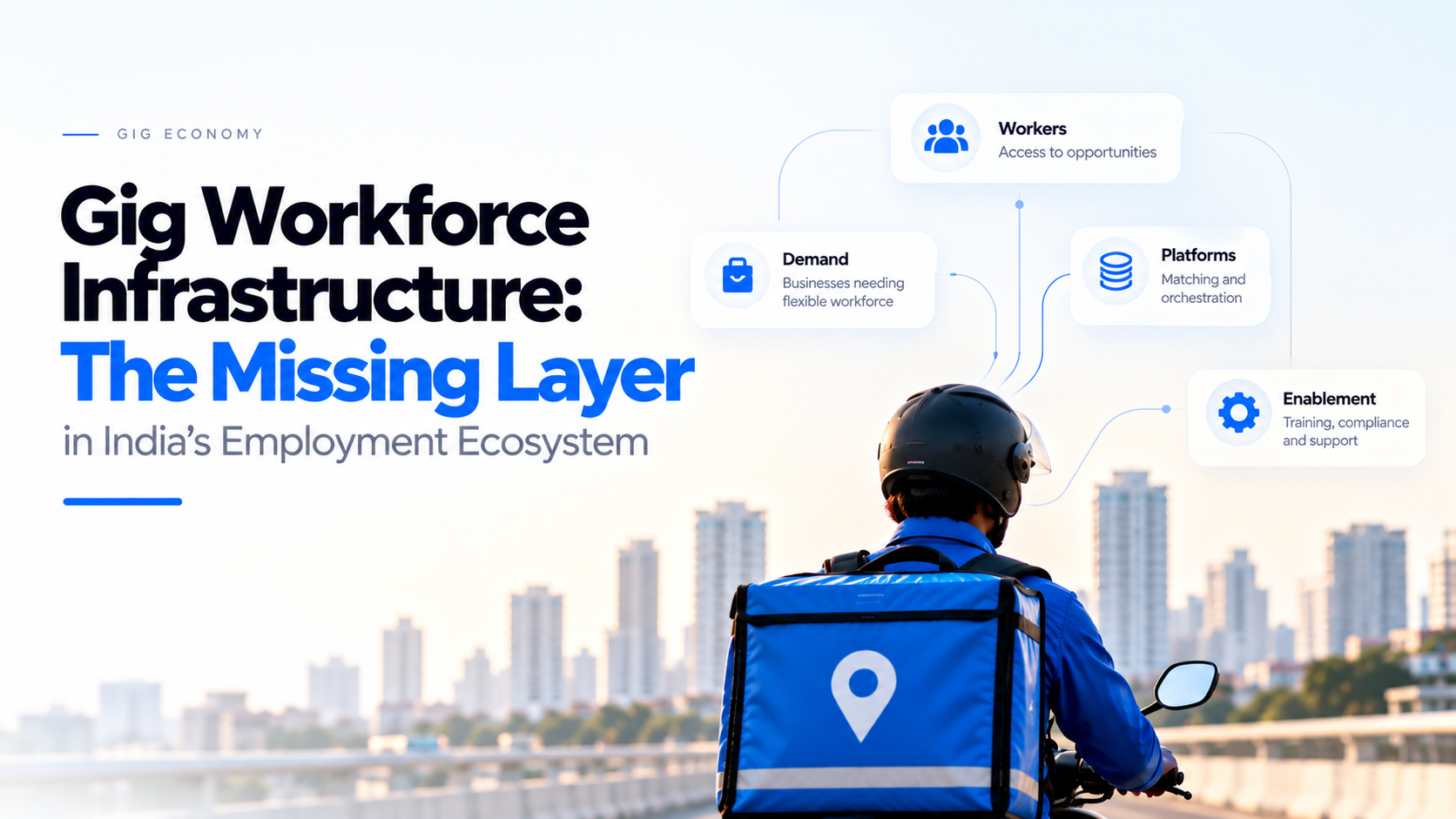
Gig Workforce Infrastructure: The Missing Layer in India's Employment Ecosystem
The man who supervises a warehouse hub on the outskirts of Guwahati keeps a drawer his job description never mentions. He is in his thirties, a transport-office assistant in an earlier life, and workers from every shift bring him their paperwork: Aadhaar corrections, bank glitches, insurance claims nobody explained, printouts of e-Shram registrations, hospital estimates for surgeries somebody hoped a scheme would cover. The drawer is, in physical form, the subject of this article. It holds every rail the gig economy has built and every gap it has left, sorted by how urgently a human being needed it at six in the evening. Platforms route his workers' labour; nobody routes their lives. He has become the missing layer, one evening at a time.
Roughly twelve million Indians earn through gig work today, as reporting on the platform workforce has documented, with official projections carrying the number past twenty million within the decade, and the machine that moves their labour is genuinely impressive: match in minutes, settle in days, scale with festivals. But the gig workforce infrastructure India needs is not the machine. It is the layer beneath the machine - the records, protections, institutions and physical provisions a worker carries across platforms, employers and years. Traditional employment accumulated that layer over a century, so gradually that nobody had to name it. The gig economy arrived in fifteen years, built only the engines, and the absence underneath is now the sector's defining structural gap. This article inventories what has been poured, measures what is missing, and asks who pours the rest.
What Infrastructure Means When the Job Is an App
Infrastructure, for a worker, is anything that keeps working when a particular job stops. A provident fund that outlives the employer is infrastructure. An identity record a new employer can verify in minutes is infrastructure. A court or board that answers when something goes wrong is infrastructure. A shaded place to park and eat between orders is infrastructure. The test is portability across time and across employers: does it belong to the worker, or to the job? By that test, the gig economy's dazzling operational machinery - the funnels, the incentive calendars, the settlement rails this series has walked - is not infrastructure at all. It belongs to the platforms, and it resets the moment the worker deletes an app.
This is why the sector's disputes keep circling the same ground. When platforms and governments argue about gig workers' status, the underlying question is never whether the work is real; it is who owns the layer beneath the work. The worker has no employer to attach benefits to, and the platform has no obligation that survives the log-out, so the layer falls between two stools that traditional employment nailed together long ago. Naming the gap precisely is the first act of closing it, because a missing layer cannot be patched by any single company acting alone - it is, by definition, a shared thing, and shared things need stewards with public mandates and patient capital.
The Rails Already Poured: An Honest Inventory
The inventory begins with identity, because every other rail depends on it. The e-Shram registration gives unorganised workers, gig workers included, a national identity number linked to their documents - the first time most of this workforce has existed as a legible record in any system. Registration does not itself pay a rupee, but legibility is the precondition for everything else: schemes find workers through records, insurers underwrite through records, credit follows records. A worker inside the identity system is a worker the rest of the infrastructure can eventually reach; a worker outside it is invisible to every rail this article will discuss.
The second rail is statutory. The Code on Social Security recognised gig and platform workers in statute in 2020, and the gig worker welfare board India has begun building - Rajasthan first in 2023, Karnataka following in 2024 - gives the recognition an address: boards funded by aggregator contributions of 1 to 2 per cent of turnover, capped at 5 per cent of payouts, designed to hold scheme money and answer worker claims. Add the 2025-26 Budget's extension of Ayushman Bharat health cover to registered gig workers and the shape of something real emerges. The honest caveat is that a young board and a registered identity are foundations, not finished rooms: the gig worker social security India is writing into law still has to travel the last distance between statute and a claim actually paid, and that last distance is where the drawer in Guwahati fills up.
A third rail is private but real: the payout and data trails platforms generate. Weekly settlements, earnings histories, completion records - these are infrastructure in waiting, and the previous article showed fintech already building on them. The inventory, honestly stated, is therefore: identity exists, statute exists, boards exist on paper, private records accumulate daily, and health cover has been promised to the registered. What does not yet exist is the composition of these pieces into a system a worker can actually carry - and between the pieces sit the gaps, which are larger than they look from inside any single platform's dashboard.
The Gaps: What Traditional Employment Had and Gig Work Lacks
Run the century test. Salaried employment in India took decades to assemble its layer: retirement funds, health insurance, gratuity, dispute machinery, unions, canteens, working-hours rules, and the quiet dignity of being a category the system recognised. None of it arrived as one reform; all of it arrived because the employment relationship gave the state and employers a fixed address to attach obligations to. The gig relationship has no such address, so the layer's components hang unanswered. The gig worker benefits India debates usually start and end with insurance, but insurance is one room in a house that is mostly unbuilt.
The sharpest gap is portability itself. Portable benefits gig workers can carry between platforms - contributions that follow the worker rather than the app, accounts that survive switching - do not exist at system level yet, and their absence shapes behaviour: a worker who loses everything by leaving is a worker who stays where he is badly treated, and a platform competing on lock-in rather than quality is a platform with the wrong incentives. The second gap is voice: gig worker grievance redressal India possesses today is mostly a chat box inside the same app that employs the worker, which is arbitration of a dispute by the disputing party. Traditional employment grew labour courts and registered unions over decades; the gig layer has neither, and until something answers when a worker is wrongly deactivated, the safety promise remains half-built.
The third gap is progression. The skills reading published by NITI Aayog puts the sector near forty per cent low-skill, thirty-two per cent medium and twenty-eight per cent high-skill work, and a healthy employment ecosystem should move people upward across that gradient. What is missing is the ladder: skilling for gig workers India offers today is largely platform-specific training that expires at the platform's edge, unrecognised by the next employer, uncertified for the next role. A delivery partner who becomes a fleet lead acquires real management skill that no record certifies; a warehouse picker who learns inventory systems carries no paper for it. The missing layer is not only protection - it is the proof-of-growth infrastructure that makes years of gig work compound into a career instead of resetting each season.
The Portable Layer: Records That Travel With the Worker
If the missing layer has a single organising principle, it is portability: every rail should attach to the worker, not the job. The e-Shram number is the anchor point, and the design question for everything built next is whether it clips onto that anchor. Welfare board benefits should read the worker's identity wherever he works this month. Earnings histories should aggregate across platforms into one income record. Training should certify the skill, not the app that taught it. A worker in Guwahati who moves from warehouse shifts to delivery routes to a seasonal return home should accumulate, not restart - and the technology for accumulation is the boring part, already solved wherever systems choose to interoperate.
Portability is already quietly proving its value on the financial rail. The credit access gig workers India never had is arriving through payout histories: weekly settlement streams that lenders can underwrite against, leases priced on behaviour rather than paperwork, insurance that attaches to verified earnings. Gig worker safety net India builds in the private market is, ironically, ahead of the public layer here - fintech found the payout rail before the state found the statute. The lesson travels: when income becomes legible and records become portable, markets build rooms the state never has to subsidise. The public layer's job is to make the same legibility work for protection, not only for credit.
Health is the portability test case already in motion. Gig worker healthcare India provides through Ayushman cover, once operational for the registered, will be the first benefits system that follows the worker across employers by design - and its success or failure will teach the sector what portability actually requires: registration rates high enough to matter, hospital systems that read the record, boards that pay without a fight. The drawer in Guwahati holds hospital estimates today because none of that plumbing is finished; when it holds discharge summaries marked covered instead, the layer will have poured its first wet concrete.
The Physical Layer: Cities That Were Not Built for This Work
Delivery partner rest points India cities are only beginning to pilot - shaded parking, drinking water, washrooms, charging points for electric fleets - are infrastructure in the oldest sense, and their absence is felt in the body before it is felt in any statistic. A rider between orders has nowhere to be: malls are hostile, footpaths are illegal, and the eight-minute wait between drops is spent curbside in the sun or the rain. The physical layer costs less than any digital rail and is the least built, because no platform owns the pavement and no statute lists a bench. City administrations, market associations and platform CSR budgets are the natural builders; some intersections in some cities have pilots, and the gap between pilots and a network is the entire distance left to travel.
Warehousing and hub work carry their own physical layer needs, more forgiving but no less real: safe docks, sanitation, shift-end transport, and the zone planning that decides whether a worker's commute eats his first hour's pay. Boards such as warehouse jobs in Bengaluru and delivery jobs in Bengaluru show how precisely operators now map demand zones, and the honest observation is that the same mapping precision has never been pointed at the worker's standing, eating or travelling. The data exists; the intent is what is missing. A sector that can predict an order to the minute can certainly predict where eight thousand riders will need shade at one in the afternoon - the physical layer is a choice, not a frontier.
Pouring the Layer: Who Builds What
The division of labour for the build is already legible in the blueprint. The state pours the public rails: identity, statutes, welfare boards, health cover, and the enforcement that turns the gig worker protection India has written into law from paper to practice. Platforms pour the private rails: payout histories, portable earnings records, training that certifies skills rather than apps, and the deactivation-review processes that decide whether grievance redressal means anything. Fintech pours the financial rooms on top of legible income. Cities pour the pavement layer: rest points, charging, parking, sanitation. And the levy - 1 to 2 per cent of aggregator turnover, capped at 5 per cent of payouts - is the funding seam that makes the public share of this build real rather than rhetorical.
The single ask that organises all of it is interoperability, because isolated rails reproduce the fragmentation they were meant to cure. A welfare board whose records cannot read an e-Shram number duplicates paperwork; a training certificate one platform ignores teaches workers not to trust certificates; an insurance scheme that pays only for workers of one app covers a labour market that spans five. The stewardship question - who maintains the layer when no single owner profits from it - is the question traditional employment answered with decades of institutions, and the boards now being staffed are the first such institutions the gig economy has owned. Their credibility will be built claim by claim, in the same way platform trust was built delivery by delivery. The sequencing matters too, because layers poured in the wrong order crack: identity before schemes, schemes before enforcement, records before credit - each step makes the next one cheap, and each one skipped forces the later build to redo earlier work. What the sector needs from its young institutions is not launch events but uptime: claims answered, records read, disputes closed.
Employers and operators have a stake that is easy to state: every functioning rail lowers the cost of hiring honestly. Verification that reads public identity is cheaper than re-proving documents; benefits that follow the worker remove the severance-shaped anxieties from flexible hiring; grievance machinery that works reduces the reputational roulette that currently prices risk into every contract. Listings such as live gig jobs and rails such as GigKaro's gig worker hiring platform already demonstrate the pattern - match on verified facts, let the worker keep his record, charge the employer for the match rather than the worker for access. Infrastructure, at the end of the day, is what lets a market grow without asking its participants to pay in vulnerability.
Reading the Layer: Takeaways for Both Sides
For jobseekers, the actionable reading is that half the layer already exists and rewards registration. Get the e-Shram number, keep the documents current, and treat every payout record as a credit file being written. Compare operators not only on pay but on infrastructure: which ones pay on the rhythm promised, answer grievances outside the app chat box, and support registrations that make benefits reachable. Start from the category directory to see the roles, scan the city listings to see who is hiring near you, and use the step-by-step guide to finding gig work near you to prepare the documents the rails require. The worker who arrives registered, recorded and documented is, in the language of this article, already standing on the layer everyone else is still pouring.
For employers, the reading is that infrastructure is becoming a competitive variable in hiring itself. As boards mature and records compound, the operators who feed the rails - honest payouts, truthful records, functioning reviews - will hire from a workforce that trusts them, at prices that reflect the trust, while operators who stay outside the layer will pay a permanence premium for every joining they want. The choice is not between profit and protection; the decade of evidence assembled in this series says the two increasingly settle in the same account.
Return to the drawer in Guwahati. There is a new folder in it now, thin and unlikely: welfare board registration acknowledgements, a handful of Ayushman cards that actually scanned at the hospital desk, an e-Shram printout that a lender read without a signature from anyone's employer. The supervisor does not call any of it infrastructure; he calls it less running around. But the difference he is describing is the layer arriving - unevenly, wet, incomplete, real. The future of work infrastructure India is pouring will be judged in rooms like his, by whether the next form a tired worker brings at six in the evening finds a system already holding it. The engines of this economy are built and they run. The decade ahead belongs to the layer beneath them.